Resume for Graphic Designer: Graphic Designer CV Template and Examples
Graphic designer resumes are screened in pairs with the portfolio. The portfolio is the evaluation; the resume is context. The strongest graphic designer resume examples lead with the portfolio link, name the project types and software, and use bullets to set up what the portfolio shows.
Free forever · No watermark · Works with Workday, Greenhouse, Lever
The short answer
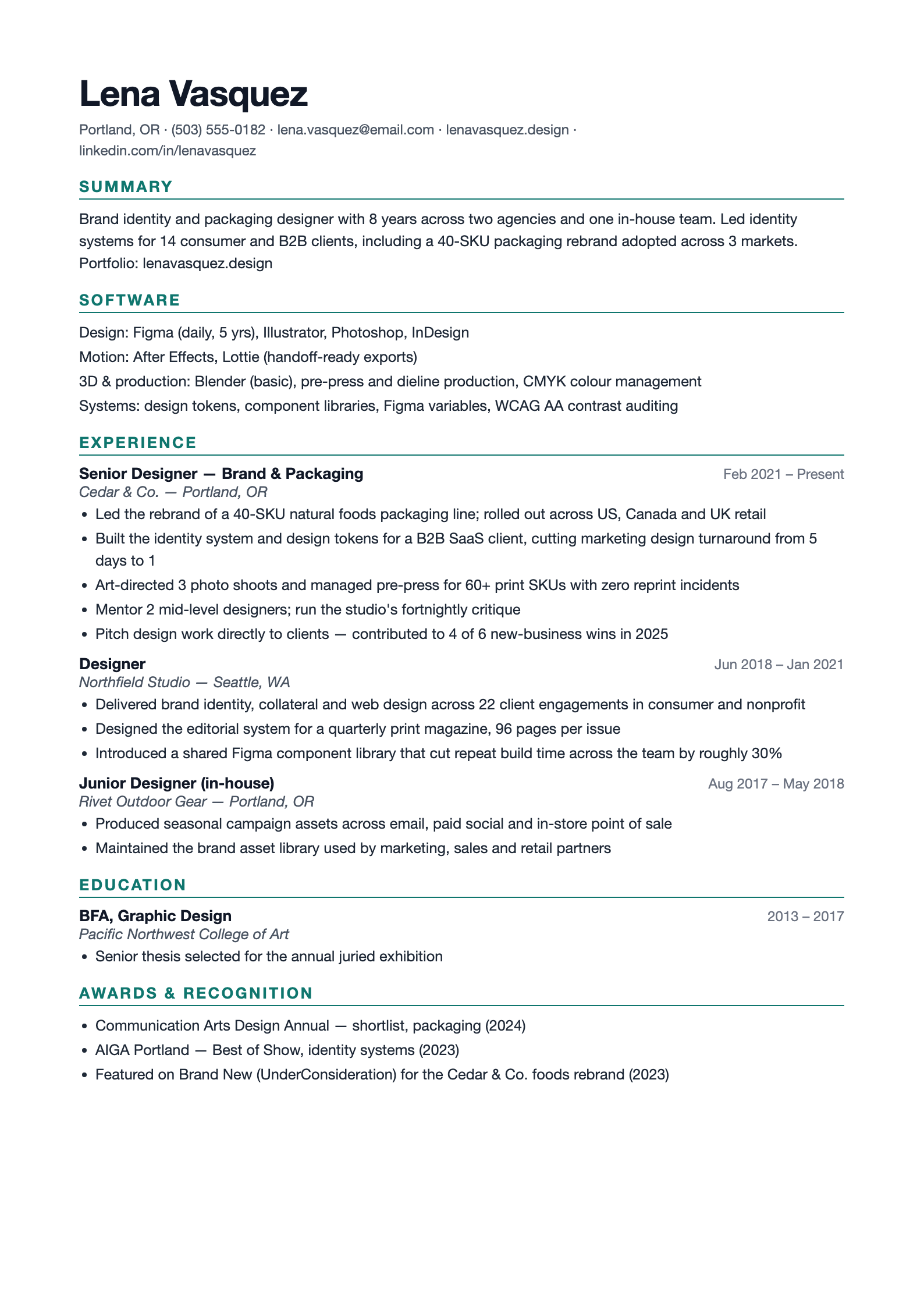
A resume for a graphic designer is one page, single-column, and exists to get the portfolio opened. Order it: contact details with the portfolio URL in the header, a two-line summary naming your discipline (brand identity, packaging, motion, UI, editorial), software proficiency, experience in reverse chronological order with the client or brand named, and education. Put the portfolio link in the header, not the footer — the portfolio is the evaluation and the resume is context for it, so a link a reviewer has to hunt for costs you the review.
Graphic designer resume examples that get shortlisted quantify the work rather than describing it: name the client, the deliverable and the outcome ("rebranded a 40-SKU packaging line, adopted across 3 markets") instead of listing "responsible for branding". The graphic designer CV template below is available free in Word and PDF, and it keeps the layout single-column on purpose — a two-column "designer" resume is the single most common reason a design CV is dropped silently by an applicant tracking system.
Download Qarera's free, ATS-ready graphic designer CV template and resume for graphic designer roles (Word + PDF) below — no sign-up, no credit card.
Download the free graphic designer CV template
A filled-in one-page graphic designer resume — portfolio URL in the header, discipline summary, software proficiency grouped by category, client work with named brands and outcomes, and education. Download the editable Word file or the PDF.
Free, no credit card. Bring your own resume and we'll restyle it to this template.
Free · no signup required to download
Why graphic designer resumes are portfolio-led
Hiring managers in design start with the portfolio. They click through it for two minutes, decide whether the work matches the role, and only then read the resume to confirm fit. A resume without a portfolio link is incomplete. The resume's job is to anchor: years of experience, project types, software fluency, agency or in-house background, and any leadership or specialty.
The second filter is project type and stage. Brand identity, packaging, motion, digital product, editorial, and environmental design all live under "graphic designer." Hiring managers screen for the right type. A resume that names the kind of work you've shipped ("Brand identity systems for 12 B2B SaaS companies") gets routed to the right pile.
The third filter is software depth. Adobe Creative Suite is baseline; Figma is now equally important; motion designers add After Effects and Cinema 4D; product designers add prototyping tools. List the depth (years, daily use), not just the package.
Graphic Designer resume builder, free and AI-powered
Open the Graphic Designer template inside the Qarera AI builder. Drop your experience in, paste a job description, and the builder rewrites your bullets to match. Export as a PDF in one click.
- ATS-friendly single-column layout
- AI-rewritten bullet points
- Keyword optimization vs job description
- Unlimited free PDF export
What to include on a graphic designer resume
Contact + portfolio link. Name, phone, email, city, LinkedIn, and the portfolio URL. The portfolio link is the most important line on the resume. Put it on the same line as the email so it never gets missed.
Professional Summary (3-4 lines). Years in design, primary project types, agency or in-house background, and one signature project or client. "Senior brand designer with 7 years across 2 agencies and 1 in-house team; led identity work for 12 B2B SaaS clients including [Company X]; comfortable in Figma, Adobe Suite, and motion (After Effects)" beats "creative graphic designer."
Experience. Reverse chronological. Studio or company, title, dates, project types. Lead each role with one signature project (client, scope, your role) and 2-3 supporting bullets covering breadth (project types), client management, mentorship, and any leadership work.
Software. Group: Design (Figma, Adobe Suite, Sketch), motion (After Effects, Cinema 4D, Lottie), prototyping (ProtoPie, Principle), 3D (Blender, Cinema 4D). Note depth, not just presence.
Education. BFA, MFA, or relevant degree, school, year. Honors and capstone if relevant. Drop GPA after 3 years out unless 3.8+.
Awards & Publications. AIGA awards, Brand New, Communication Arts, Print, Brand New Conference, etc. Specific recognitions are credibility signals.
Graphic design skills for your resume, measured from live job postings
Every other graphic design skills list is somebody's opinion about what belongs on a designer's CV. This one is a count taken from the live graphic designer jobs in our index: the specific skills employers ask for most often, and how often each one actually appears — so you can decide what earns space on a one-page resume whose only job is to get your portfolio opened.
Based on 403 live graphic designer postings on Qarera (a quarter US, a fifth India, then Egypt, the UK and the Gulf), measured 2026-08-24.
- Adobe Illustrator48.9%
The most-requested tool of any kind, in almost half of postings. Write it out in full — 'Ai' is the file extension, not a string a keyword filter matches. Then say what you build in it: logo systems, vector icon sets, packaging dielines.
- Adobe Photoshop46.9%
Asked for almost as often as Illustrator, and usually named in the same sentence — list one without the other and the pair reads as incomplete. Retouching, compositing and export-for-web are the uses worth naming.
- Typography38.2%
The most-requested skill that is not a piece of software, and the thing that separates a designer from someone who owns Adobe. Prove it with a type system you built or a pairing decision you can defend. 'Color theory' appears in 7.7% of postings and belongs on the same line.
- Adobe Creative Suite38%
Postings ask for the suite by name about as often as they ask for individual apps, so write both — the suite line for the filter, the named apps for the human. 10.7% use Adobe's current branding, 'Creative Cloud'; mirror whichever the posting uses.
- AI and AI-assisted design tools35.5%
Read this number with care: our extractor matched the bare word 'AI', so it mixes postings that genuinely want AI-assisted design with postings where AI only describes the employer's own product. The underlying ask is real in 2026 — so name the tool and the job it did (generative fill for extends, Firefly or Midjourney for concept boards, AI upscaling for asset reuse) and never write the bare acronym. Across our whole index 'AI' appears in 17% of postings, so design ads ask roughly twice as often as average.
- Adobe InDesign35.2%
Print and editorial still carry a third of the market. If you have pre-press experience — CMYK, bleed, imposition, packaging dielines — put it here; it is the part of InDesign that is hard to fake and rarely claimed.
- Attention to detail35%
Every applicant claims it, so the phrase alone is worth nothing. Prove it with an artefact: brand guidelines you maintained, a 40-page catalogue you proofed to press, a file-naming and handoff convention you set for the team.
- Figma31.3%
In roughly one posting in three, and leaving it off is the fastest way to date a graphic-design CV. Name what you do in it — components, auto-layout, prototypes, dev handoff — because the bare word reads as 'I have opened Figma'. 'Design systems' is asked for separately in 6.9% of postings and is thinly enough claimed to differentiate you: give the component count and how many teams consumed it.
- Layout and composition25.8%
Grid systems, hierarchy and page architecture. Best evidenced by the artefact rather than the adjective: a multi-page report, a catalogue, or a template set other people used without your help.
- Branding and brand identity20.3%
Every designer's portfolio has a logo in it, so say what you shipped and how far it travelled — 'identity system adopted across 3 markets and 14 properties' — not 'responsible for branding'.
- Presentation and deck design16.9%
A real deliverable, not a soft skill: pitch, sales and investor decks are a large share of the work in in-house roles. Name the volume and the audience the deck was built for.
- Visual storytelling15.4%
Design-hiring shorthand for whether your portfolio explains itself. Structure at least two case studies as brief → constraint → decision → outcome; that structure is what the phrase is actually asking for.
- Canva15.1%
One posting in seven asks for it, and designers routinely leave it off because it feels beneath them. What the employer wants is someone who can build locked templates non-designers can safely use — say that, and it stops being an admission.
- Motion graphics15.1%
Motion has moved from specialism to expectation, and even one piece in the portfolio is worth naming. 'Motion design' (11.9%) and 'animation' (10.2%) are the same ask in different words — use the posting's wording.
- After Effects13.6%
The tool behind the motion ask. List it on its own line rather than folding it into the suite — filters match the product name, not the category it belongs to.
- Premiere Pro12.7%
Short-form video edit work now sits inside a lot of graphic-design jobs; the plainer phrase 'video editing' appears in 10.4% of postings. Name the output — social cuts, event recaps, product demos — and the typical run time.
- PowerPoint11.2%
Genuinely asked for, and almost never listed by designers who consider it beneath them. Add it, and Google Slides, if you can build a master-slide template — that specific thing is what is being asked for.
Counted across 403 live graphic designer, visual designer and brand designer postings indexed on Qarera on 24 August 2026: 104 United States, 89 India, then Egypt, the UK, Qatar, Germany and the Netherlands, with 33 carrying no country. This is the smallest sample of the roles we have measured, so read anything under about 10% as indicative rather than precise — one percentage point here is four postings. The list is curated, not the raw ranking. We dropped words that name the job rather than a skill ('graphic design' 41.9%, 'visual communication' 16.6%, 'graphics' 11.9%, 'visual design' 9.7%, 'art' 8.7%), the channel and industry words that describe what a designer is hired to serve rather than a skill they hold ('marketing' 47.6%, 'social media' 26.6%, 'video' 16.6%, 'digital marketing' 12.7%, 'advertising' 8.9%) — those are still worth naming inside your bullets, just not in a skills list — boilerplate our extractor lifts out of job-description prose ('materials', 'assets', 'channels', 'ads', 'email'), adjectives we could not tell you how to prove ('creativity' 11.4%), and terms that are no more common in design hiring than in hiring generally — 'communication' appears in 38.0% of these postings but 32.6% of all 372,607 live postings we hold, a difference too small to be worth your skills section, so it sits in the hard-and-soft skills list further down instead. One entry needs its caveat stated plainly rather than buried: 'AI' at 35.5% was matched as a bare word, and reading the sentences it came from shows it splits two ways — postings that genuinely ask for AI-assisted design work, and postings where AI only describes the employer's own product or market ('the #1 AI CRM', 'built for AI workloads'). We have kept it because for design work in 2026 the ask is real, and labelled it for what it is rather than presenting it as a verified tool requirement. Calibrate it against the whole index: 'AI' is the second most common term across all 372,607 live postings we hold, at 17%, so a design posting mentions it about twice as often as an average posting — a genuine lift, but not a clean one. Near-duplicates are merged and reported under the higher-counting term only; the percentages are never added together. 'Illustrator' (48.9%) absorbs 'Adobe Illustrator' (14.9%), 'Photoshop' (46.9%) absorbs 'Adobe Photoshop' (16.1%), 'Adobe Creative Suite' (38.0%) absorbs 'Adobe Creative Cloud' (10.7%) and the bare word 'Adobe' (6.0%), 'InDesign' (35.2%) absorbs 'Adobe InDesign' (6.5%), 'layout' (25.8%) absorbs 'composition' (11.9%), 'branding' (20.3%) absorbs 'brand design' (11.4%) and 'brand identity' (7.7%), 'presentations' (16.9%) absorbs the singular 'presentation' (8.9%), 'visual storytelling' (15.4%) absorbs 'storytelling' (9.9%), 'motion graphics' (15.1%) absorbs 'motion' (13.9%), 'motion design' (11.9%) and 'animation' (10.2%), 'After Effects' (13.6%) absorbs 'Adobe After Effects' (7.2%), and 'Premiere Pro' (12.7%) absorbs 'video editing' (10.4%). Labels are expanded for readability — the percentage shown against a label is always the count for that single term.
Hard and soft skills for a graphic designer resume
The measured list above tells you what employers ask for. This one sorts the vocabulary into the two groups a screener treats differently: hard skills a keyword scanner can verify, and soft skills that count only when a bullet proves them.
Hard skills
- •Figma (design + prototyping + handoff)
- •Adobe Suite (Illustrator, Photoshop, InDesign, XD)
- •Brand identity systems and design tokens
- •Print production (CMYK, bleed, pre-press)
- •Web and digital product design
- •Motion graphics (After Effects, Lottie, Principle)
- •Editorial and publication design (InDesign)
- •Packaging and dieline production
- •Design systems and component libraries
- •Accessibility and inclusive design (WCAG)
Soft skills
- •Client and stakeholder presentation
- •Briefing and creative direction
- •Critique participation and giving
- •Mentoring junior designers
- •Cross-functional partnership with copy, dev, marketing
- •Time management across concurrent projects
ATS keywords for graphic designer resumes
These are the terms applicant tracking systems are tuned to find on a graphic designer resume. Embed them naturally in your bullets and skills section - don't list them as a flat keyword wall.
Sample graphic designer resume bullets
Use these as a model - replace the numbers and contexts with your own. Every bullet leads with a quantified outcome, not a duty.
- 1
Led brand identity refresh for a Series C SaaS company (700 employees); shipped logo system, type pairings, and brand guidelines used across web, marketing, sales, and product surfaces; rolled to 14 properties in 8 weeks.
- 2
Designed and shipped 12 monthly product marketing campaigns at a B2B agency, each spanning email, paid social, and landing page hero; client retention across the book grew 18% YoY during my tenure.
- 3
Built and maintained the in-house design system in Figma covering 240 components used by 6 product squads; documentation and component contributions adopted by the engineering team without bug regressions.
- 4
Mentored 2 junior designers through their first quarter; both shipped a meaningful project to a client by month two and one was promoted to mid-level designer within the year.
- 5
Created motion identity (After Effects + Lottie) for a fintech app's onboarding flow; reduced first-screen drop-off 14% in user testing and shipped to production in the same release cycle.
- 6
Won AIGA chapter award for an editorial system designed for a national nonprofit's annual report; system was extended to their quarterly publications without redesign over the following 18 months.
Recommended resume structure
Section order matters. ATS systems and human screeners both expect this layout for graphic designer resumes.
- 1Contact + Portfolio Link
- 2Professional Summary
- 3Experience
- 4Software
- 5Education
- 6Awards & Publications
The portfolio link is the most important line. Put it on the same line as the email. Resume is context for the portfolio; let the portfolio do the design work. Resist the urge to over-design the resume itself; ATS parsing breaks on heavily designed resumes.
Relevant certifications
- Adobe Certified Professional (any of: Photoshop, Illustrator, InDesign, After Effects)
- Figma Professional Certification
- AIGA Membership and chapter recognitions
- Google UX Design Certificate (for product designers)
- Print and packaging production training (varies)
Salary range (USD)
$50,000 – $130,000
Median $72,000
Source: bls.gov + AIGA design salary survey (2025) · As of 2025-08-01
Common mistakes on graphic designer resumes
Missing portfolio link
Hiring managers in design click portfolios within seconds. A resume without a link forces the agency to ask, and many won't. Put the URL in the contact block on the same line as the email.
Designing the resume itself too aggressively
Highly designed resumes break ATS parsing. Keep the resume clean and let the portfolio be the design showcase. The contradiction is real but the screen is real too.
Vague project descriptions
"Designed marketing materials" tells nothing. Name the client (or category if confidential), the deliverable (brand identity, packaging, web hero, motion piece), and one outcome (launched, adopted, awarded).
Listing every Adobe app
If your skills section says every Adobe package, the hiring manager assumes most are surface. Pick the 6-8 you actually use day to day and let the bullets prove the rest.
No client roster or project type breakdown
Agency designers benefit from a brief client list (or industry types if NDA-bound). In-house designers benefit from naming the product surface they design for. Both signal scope fast.
Generic 'creative thinker' language
Every designer claims this. Replace with one specific creative decision and its outcome from the portfolio's strongest project.
Frequently asked questions
Related roles
Web Developer Resume
Free template, examples, and ATS keywords for web developer resumes.
Architect Resume
Free template, examples, and ATS keywords for architect resumes.
Marketing Resume
Free template, examples, and ATS keywords for marketing resumes.
Manager Resume
Free template, examples, and ATS keywords for manager resumes.
Executive Resume
Free template, examples, and ATS keywords for executive resumes.
Build a graphic designer resume in 10 minutes
Free template, AI rewrites, ATS-tested. No watermark.
Free forever · Works with every major ATS · No credit card
Build my resume free