Customer Service Resume: Examples, Samples, and the Skills and Qualities to List
A customer service resume is judged on three things: communication signal, conflict-handling examples, and measurable customer-impact metrics. This page shows you the resume structure, skills, and bullet phrasing that get past ATS screening at retail, SaaS, and call-center employers - plus a free template you can fill in inside our AI builder.
Free forever · No watermark · Works with Workday, Greenhouse, Lever
The short answer
A customer service resume is one page, single-column, in this order: contact details, a two-line summary naming your channel mix and volume, a customer service skills section, experience in reverse chronological order with metrics attached, tools (Zendesk, Salesforce Service Cloud, Freshdesk, Intercom), and education. The customer service skills to put on a resume split into two groups that are judged differently: verifiable hard skills — ticketing systems, CRM platforms, languages spoken, typing speed, channels handled — which an ATS can match, and the customer service qualities for a resume — patience, de-escalation, empathy, active listening — which are worth nothing as a bare list and everything when attached to a number or an example.
The single change that most improves a customer service resume sample is putting volume and outcome on every bullet: tickets or calls per day, CSAT or NPS, first-contact resolution rate, average handle time, and escalation rate. "Handled customer enquiries" and "provided excellent service" are the two most common lines on the weakest applications. The customer service resume examples and the free sample CV below are written to that standard, in Word and PDF.
Download Qarera's free, ATS-ready customer service resume sample and CV template (Word + PDF) below — no sign-up, no credit card.
Download the free customer service resume sample
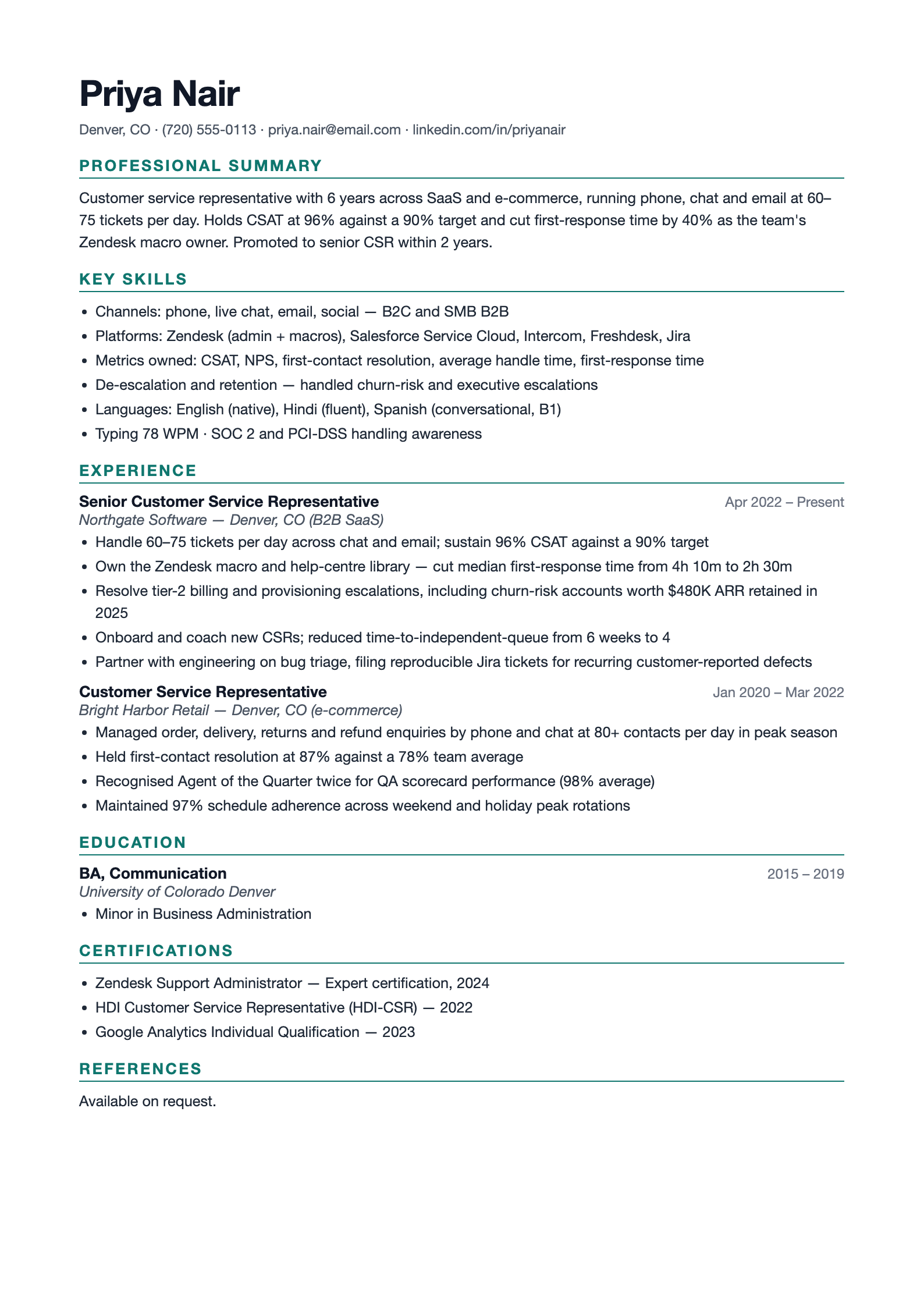
A filled-in one-page customer service resume — channel and volume summary, a skills section split into verifiable tools and evidenced qualities, experience with CSAT, first-contact resolution and handle-time metrics attached, and the ticketing platforms recruiters screen for. Download the editable Word file or the PDF.
Free, no credit card. Bring your own resume and we'll restyle it to this template.
Free · no signup required to download
Why customer service resumes are different
Customer service is one of the most-applied-to job categories in the US, and most CSR resumes look identical. "Excellent communication skills, team player, customer-focused, problem solver." The hiring manager has read 200 of these by the time they get to yours; the assumption is that every applicant has these traits, so listing them adds no signal.
What actually moves the screen in customer service is metrics. CSAT score, NPS, first-call resolution rate, average handle time, ticket volume per day, retention dollars saved. A bullet that includes one of these numbers immediately beats four that don't, because numbers are the one signal that's hard to fake. Hiring managers in customer service know what "good" looks like for these metrics in their industry; if your numbers are within range, you're a real candidate. If they're not on the resume at all, you're an unknown.
The second differentiator is industry context. A customer service resume that worked in a SaaS B2B environment is structured differently from one that worked at a retail call center, which is different from a hospitality front-desk role. Mention the industry, the customer type (consumer, SMB, enterprise, internal), the channels you ran (phone, chat, email, social), and the systems you used. These specifics are what let a hiring manager mentally place you in their environment.
The third thing is escalation work. Anyone can take an easy ticket. The differentiator is whether you handle the angry customer, the churn-risk account, the bug-driven mass complaint, the complex multi-team escalation. One bullet about a hard escalation you handled well is worth ten about routine work.
Customer Service Representative resume builder, free and AI-powered
Open the Customer Service Representative template inside the Qarera AI builder. Drop your experience in, paste a job description, and the builder rewrites your bullets to match. Export as a PDF in one click.
- ATS-friendly single-column layout
- AI-rewritten bullet points
- Keyword optimization vs job description
- Unlimited free PDF export
What to include on a customer service resume
Contact. Name, phone, email, city. Languages if you're bilingual or multilingual - explicitly call them out, since support roles often pay a premium for second-language fluency.
Professional Summary (3-4 lines). Years in customer service, channels you've run, and one quantified metric. "Customer support specialist with 4 years across phone, chat, and email; consistent 96% CSAT and 4.8-minute average handle time on a B2B SaaS team" beats "highly motivated customer service professional."
Core Skills. Group hard skills (CRM platforms, support tools, business systems) separately from soft skills. Hard skills first because that's what ATS scanners and human screeners both anchor on.
Experience. Reverse chronological. Company, title, dates, location. Lead each role with a metric - CSAT, NPS, FCR, AHT, retention dollars, or volume. Then 3-4 supporting bullets covering escalation handling, training/mentoring, KB authoring, and any process improvement you ran.
Education. Degree, university, graduation year. CSR roles rarely require a degree, but if you have one, list it. If you're entry-level, GPA helps if it's 3.5+.
Certifications (optional but useful). HDI Customer Service Representative (HDI-CSR), Salesforce Service Cloud, Zendesk Support Administrator, ICMI certifications. These signal you've invested in the craft and weren't just thrown into a queue.
Languages. A separate line. List languages and proficiency (Native, Fluent, Conversational). Bilingual support is one of the highest-paid CSR specializations - make sure it's visible.
What to leave off. Generic soft-skill lists, customer service philosophy statements, a paragraph about your love of helping people. None of these add signal.
Customer service skills employers actually ask for, measured from live postings
Most “customer service skills” lists are somebody’s opinion. This one is a count. We read the 4,916 live customer service, customer support and customer care postings indexed on Qarera and counted how often each skill is named, then compared each against how often it appears across all 374,306 live postings we hold — because a skill that every job asks for tells you nothing about this one. Tick what you can genuinely evidence and we will carry it into the builder.
Based on 4,916 live customer service representative postings on Qarera (1,821 United States, 604 India, 467 United Kingdom, then Australia, the Philippines, Canada, Germany and Malaysia), measured 25 August 2026.
- Attention to detail18.8%
The most-requested trait in this sample by a wide margin. Prove it with a number rather than the phrase: order accuracy, error rate, QA score, or how many tickets you handled without a rework.
- Written communication10.7%
Support has shifted to text. Say which channels you wrote in and at what volume — 'wrote 60+ email and chat responses a day' beats 'excellent written communication'.
- CRM software8.3%
Counted as the bare term 'CRM'; a further 3.3% name 'CRM systems' and 4.9% name Salesforce specifically. Name your actual system and what you did in it, not just the acronym.
- Empathy7.7%
Nearly eight times more common here than in hiring generally, so it is worth the line — but only attached to an outcome, such as a retained account or a complaint closed without escalation.
- SAP5.8%
Genuinely a requirement, not a mis-tag: postings list it beside Salesforce and Epicor as the system a rep must operate to check stock, orders and invoices.
- Microsoft Office5%
Low-glamour and still asked for. One line at the bottom of your skills list is enough; do not spend a bullet on it.
- Call center and contact center experience4.5%
Counted as 'call center' (4.5%); 'call center experience' appears in 2.9% and 'contact center' in 1.9%, reported separately and never added together. Name the queue type and daily volume.
- Multi-tasking4.1%
Counted as the hyphenated spelling; the unhyphenated 'multitasking' adds a separate 2.1%. Show it concretely — concurrent chats, or phone while updating the CRM.
- Order handling4%
Counted as 'orders'; 'order' appears in 3.0% and 'order management' in 2.1%. Say what you actually did to an order: placed, amended, tracked, refunded, escalated.
- Inventory3.6%
Real rep work in retail and distribution, not a warehouse mis-tag — postings ask for sourcing stock across branch, distribution-centre and supplier inventory to fill a customer order.
- Customer satisfaction (CSAT)3.5%
Quote your actual score and the sample behind it. 'CSAT 4.7 over 900 surveys' is evidence; 'committed to customer satisfaction' is not.
- Voice and non-voice support3.3%
BPO vocabulary, and it matters for this audience — India and the Philippines are 829 of these postings, and they hire explicitly for 'voice' or 'non-voice' process. Use the employer's own term.
- Payments and billing3.1%
Counted as 'payment'; 'billing' appears separately in 2.0%. Mention refunds, chargebacks or disputes if you handled them — that is the part employers screen for.
- Listening2.8%
Counted as the bare term; 'active listening' is a separate 2.7% and is not added to it. Both are hard to prove — pair with a first-contact-resolution figure if you have one.
- Live chat2.7%
Chat is asked for far more often than any named chat tool. Lead with the channel and your concurrency, then name the tool.
- Resilience2.6%
Appears more often than de-escalation does. Employers are screening for staying steady through repetitive volume, not just for handling one angry caller.
- Data entry2.5%
Unglamorous and repeatedly requested. Tie it to accuracy or speed, or it reads as filler.
- Sales targets2.1%
Worth knowing before you apply: a meaningful share of 'customer service' roles carry a quota. If yours did, put the attainment on the resume; if you want a non-sales role, read the posting carefully.
Counted across 4,916 live customer service, customer support and customer care postings indexed on Qarera on 25 August 2026: 1,821 United States, 604 India, 467 United Kingdom, then Australia, the Philippines, Canada, Germany and Malaysia. This list is curated, not the raw ranking, and every exclusion below is deliberate. We dropped the words that name the job rather than a skill — 'customer service' itself (53.0%), 'customer support' (10.8%), 'customer experience' (10.2%), 'customer care' (7.7%), 'customer service skills' (4.0%), 'customer service orientation' (4.0%) and 'customer-facing' (3.2%). A list telling you that customer service jobs want customer service is not worth your time. We also dropped every term that is no more common here than in hiring generally, measured against all 374,306 live postings we hold. 'Communication' appears in 39.5% of these postings but 32.6% of every posting; 'leadership' in 6.6% against 16.2%; 'collaboration' in 6.1% against 10.0%; 'verbal communication' in 6.5% against 5.8%. The clearest case is AI: it appears in 5.0% of customer service postings and 16.9% of postings overall, so a customer service job is more than three times less likely than an average job to mention it. Those terms belong on your resume — they are in the hard and soft skills list further down — but they do not distinguish this role, so they are not presented here as if measurement had found them. Industry words were dropped too, because they describe the employer rather than the candidate: 'retail' (7.0%), 'healthcare' (5.7%), 'logistics' (4.7%), 'banking' (8.1%) and 'betting' (2.0%). Banking is additionally contaminated by the anti-fraud paragraph employers paste into postings ('we will never ask you for banking information during the hiring process'), which our extractor reads as a skill. So are 'ladder' (1.9%) — almost every match is a physical requirement to climb one — along with 'packing', 'fax', 'facility' and 'equipment'. Near-duplicates are merged and reported under one term only; the percentages are never added together. 'CRM' (8.3%) is reported without adding 'CRM systems' (3.3%) or Salesforce (4.9%); 'call center' (4.5%) without 'call center experience' (2.9%) or 'contact center' (1.9%); 'multi-tasking' (4.1%) without 'multitasking' (2.1%); 'orders' (4.0%) without 'order' (3.0%) or 'order management' (2.1%); 'listening' (2.8%) without 'active listening' (2.7%); 'payment' (3.1%) without 'billing' (2.0%). One posting can contain several spellings, so summing them would overstate every figure. Two things worth knowing that the numbers above cannot show, because they come from a different and looser measure — searching the raw text of the same 4,916 postings rather than matched skill terms. Text search always reads higher than term matching, so these are not comparable with the percentages above and are reported separately. First, the named help-desk tools every resume guide tells you to list are rarer than you would think: Zendesk appears in 2.6% of postings, Intercom 0.8%, Freshdesk 0.7%, and Five9, Genesys and Avaya together 0.4%. Naming the channel and your volume travels further than naming a tool. Second, de-escalation — a fixture of every customer service skills listicle — appears in 0.5%. SLAs (4.5%) and ticketing systems (3.7%) are asked for roughly nine and seven times more often, and neither is a term our extractor records, which is why they are described here rather than charted above.
Hard and soft skills for a customer service representative resume
The measured list above tells you what employers ask for. This one sorts the vocabulary into the two groups a screener treats differently: hard skills a keyword scanner can verify, and soft skills that count only when a bullet proves them.
Hard skills
- •CRM software (Salesforce, Zendesk, HubSpot Service Hub)
- •Ticket triage and SLA management
- •Voice and non-voice process support
- •Live chat and email support tools (Zendesk, Intercom, Freshdesk)
- •Order management, returns and refunds (Shopify, NetSuite, SAP)
- •Knowledge base authoring
- •Multi-channel support (phone, chat, email, social)
- •Microsoft Office and Google Workspace
- •Bilingual support (if applicable, list languages)
Soft skills
- •Active listening
- •Empathy under pressure
- •Resilience through repetitive volume
- •Conflict de-escalation (rarely named in postings — prove it with an outcome)
- •Patience with technical complexity
- •Clear written communication
- •Adaptability across channels
ATS keywords for customer service representative resumes
These are the terms applicant tracking systems are tuned to find on a customer service representative resume. Embed them naturally in your bullets and skills section - don't list them as a flat keyword wall.
Sample customer service representative resume bullets
Use these as a model - replace the numbers and contexts with your own. Every bullet leads with a quantified outcome, not a duty.
- 1
Resolved 60+ customer tickets per day across phone, chat, and email while maintaining a 96% CSAT score and a 4.8-minute average handle time.
- 2
Reduced first-response time from 14 minutes to 4 minutes by drafting 32 new Zendesk macros, used by 18 agents on the team.
- 3
De-escalated 22 churn-risk accounts in Q3, retaining $180k in annualised revenue and earning the highest team retention rate of the quarter.
- 4
Trained 6 new hires through 2-week onboarding, reducing average ramp time from 6 weeks to 4 weeks while maintaining quality scores above 90%.
- 5
Identified a recurring billing-error pattern affecting 1,200 customers, escalated to engineering, and led the customer-comms playbook that prevented churn.
- 6
Authored 28 KB articles cited in 14% of all support tickets, deflecting an estimated 600 tickets per quarter.
Recommended resume structure
Section order matters. ATS systems and human screeners both expect this layout for customer service representative resumes.
- 1Contact
- 2Professional Summary
- 3Core Skills
- 4Customer Service Experience
- 5Other Experience
- 6Education
- 7Certifications
- 8Languages
Lead with a 3-line professional summary that states years in CSR + your highest CSAT/NPS metric. Recruiters scan this first; if no metric appears, the resume reads as generic.
Relevant certifications
- HDI Customer Service Representative (HDI-CSR)
- Salesforce Service Cloud Consultant
- ICMI Certified Contact Center Professional
- Zendesk Support Administrator
- Customer Service Manager (CSM) by ICMI
Salary range (USD)
$32,000 – $58,000
Median $39,000
Source: bls.gov · As of 2025-05-01
Common mistakes on customer service resumes
No metrics anywhere
If your resume doesn't have a CSAT, NPS, AHT, FCR, or retention number on it, you're indistinguishable from every other applicant. Even if your last employer didn't share metrics with you, estimate ("handled 60+ tickets/day") rather than omit.
Generic soft-skill lists
"Excellent communication, team player, customer-focused" reads the same on every CSR resume. Replace with bullets that prove the trait - "de-escalated 22 churn-risk accounts in Q3, retaining $180k in ARR" proves communication and customer-focus in one line.
Not mentioning the CRM you used
Salesforce Service Cloud, Zendesk, Intercom, HubSpot Service Hub, Freshdesk - these are explicit ATS keywords on most CSR job postings. If you used one, name it. If you used several, list them all in the Skills section.
Skipping the industry context
A retail CSR resume reads differently from a SaaS CSR resume. Always name the industry, customer type (consumer, SMB, enterprise), and channel mix. Hiring managers screen by environment fit and need this context to slot you in.
Burying escalation work
Anyone can take an easy ticket. The differentiator is handling the hard one. If you handled a recurring issue, a major incident, or a high-value churn risk, that should be a top-3 bullet, not buried.
Listing every customer service job since high school
Cap at the last 10 years and the last 4-5 roles. A long employment list signals churn, not experience. Consolidate part-time or short-stint roles into one entry.
Need a cover letter too?
A customer service representative resume gets you screened in. The cover letter gets you interviewed. We have a free generator and a customer service representative-specific template ready to use.
Customer Service Representative cover letter examples →Frequently asked questions
Related roles
Sales Resume
Free template, examples, and ATS keywords for sales resumes.
Restaurant Server Resume
Free template, examples, and ATS keywords for restaurant server resumes.
Barista Resume
Free template, examples, and ATS keywords for barista resumes.
Resume with No Experience Resume
Free template, examples, and ATS keywords for resume with no experience resumes.
First Job Resume
Free template, examples, and ATS keywords for first job resumes.
Student Resume
Free template, examples, and ATS keywords for student resumes.
Manager Resume
Free template, examples, and ATS keywords for manager resumes.
Internship Resume
Free template, examples, and ATS keywords for internship resumes.
Build a customer service representative resume in 10 minutes
Free template, AI rewrites, ATS-tested. No watermark.
Free forever · Works with every major ATS · No credit card
Build my resume free