CV for Doctors: Doctor CV Format, Template and Examples
A doctor's CV is read in a fixed order: registration and licence first, clinical posts second, everything else third. Whether you are applying through the GMC in the UK, ECFMG in the US, DHA or MOH in the Gulf, or the AMC in Australia, the recruiter checks that you are eligible to practise before reading a single clinical bullet. This page shows the doctor CV format that puts those facts where they are looked for, with examples and a free template.
Free forever · No watermark · Works with Workday, Greenhouse, Lever
The short answer
The standard CV format for doctors is a two-to-four-page, single-column document in this order: contact details with your registration number, personal statement, medical registration and licensing, clinical experience by post with specialty and hospital named, procedures and competencies with numbers, education and qualifications from MBBS onward, audit and quality improvement, publications and presentations, teaching, courses and certifications, and referees. Put registration above experience: a recruiter checks that you are licensed, and on what route, before reading anything clinical. A doctor's CV is deliberately longer than a resume - compressing it to one page removes the rotations, procedure log and audit work that actually differentiate you.
The same document is called a CV for doctors, a doctor CV format, a medical CV or a physician CV. The US is the exception: American hospital and group practices often ask for a one-to-two-page resume for non-academic clinical posts, while academic medicine still uses the full CV. If you are an international medical graduate applying abroad, name your route explicitly - PLAB or MRCP for the UK, USMLE and ECFMG certification for the US, DHA / HAAD / DOH / MOH for the Gulf, AMC for Australia - because that line decides which pile your application lands in.
Download Qarera's free, ATS-ready doctor CV format and medical CV template (Word + PDF) below - no sign-up, no credit card.
Download the free doctor CV template
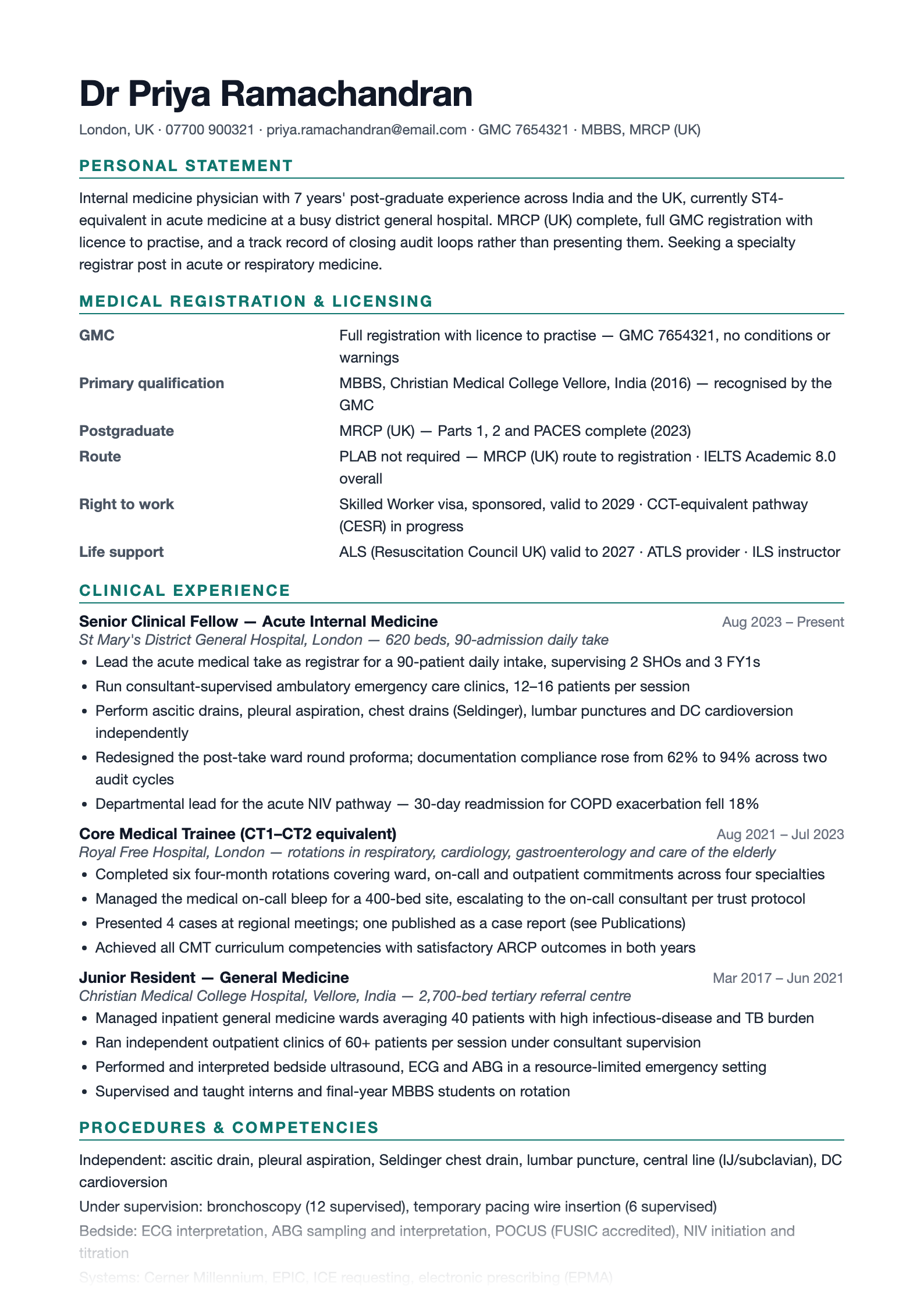
A filled-in two-page doctor CV - contact block with registration number, personal statement, Medical Registration and Licensing, Clinical Experience by post with specialty and rotation detail, Procedures and Competencies with numbers, Education and Qualifications from MBBS onward, Audit and Quality Improvement, Publications and Presentations, Teaching, Courses and Certifications, and Referees. Download the editable Word file or the PDF.
Free, no credit card. Bring your own resume and we'll restyle it to this template.
Free · no signup required to download
Why a doctor's CV is different
A doctor's CV is screened in a fixed order, and the order is not negotiable. Registration and licence come first: the recruiter, medical staffing officer or credentialing team confirms you are eligible to practise in that jurisdiction before a clinician ever sees the document. If your GMC number, ECFMG status, DHA eligibility letter or AMC certificate is not visible in the first few lines, the application can sit unprocessed regardless of how strong the clinical content is.
The second filter is specialty and grade fit. A doctor with four years in acute internal medicine is a different hire from one with four years in general practice, and the CV has to make the match obvious. Name the specialty, the hospital and its size, the patient population, the on-call commitment and the grade you worked at. "Managed inpatients" tells a clinical lead nothing; "led the acute medical take for a 90-admission daily intake, supervising two SHOs" tells them exactly where you would slot in.
The third differentiator is the evidence layer that only the CV format has room for: a procedure log with numbers, audit cycles you closed rather than started, publications, presentations and teaching. This is why a doctor's CV runs two to four pages and sometimes more. Compressing it into a one-page resume to imitate the American corporate convention deletes precisely the sections that distinguish two otherwise identical applicants.
One caveat worth stating plainly, because most sites do not: the United States is the exception to nearly all of this. American hospital and group-practice applications for non-academic clinical roles often want a one-to-two-page resume, and US academic medicine still expects the full CV. Decide which document you are writing before you write it.
Doctor resume builder, free and AI-powered
Open the Doctor template inside the Qarera AI builder. Drop your experience in, paste a job description, and the builder rewrites your bullets to match. Export as a PDF in one click.
- ATS-friendly single-column layout
- AI-rewritten bullet points
- Keyword optimization vs job description
- Unlimited free PDF export
What to include on a doctor CV
Contact and credentials. Name with your post-nominals (Dr Priya Ramachandran, MBBS, MRCP), phone, email, city, and your registration number in the header itself. Recruiters should not have to hunt for it.
Medical registration and licensing. The single most important block, and it belongs above experience. State the regulator, your number, your registration status and any conditions. For international medical graduates, name your route explicitly: PLAB or MRCP for the UK, USMLE Steps and ECFMG certification for the US, DHA / HAAD / DOH / MOH for the Gulf, AMC for Australia, MCC for Canada. Add your English test if the post requires one (IELTS Academic or OET), because that is a hard gate on most international applications.
Clinical experience. Reverse chronological, by post. For each: job title and grade, hospital with bed count or catchment, specialty, dates, and what you were responsible for. Name your on-call commitment and your level of supervision. Rotations should be listed with the specialty and duration, not summarised as "various rotations".
Procedures and competencies. A distinct section, with numbers, split by whether you perform each independently or under supervision. This is the fastest credibility signal on a medical CV and the section most doctors leave out or under-count.
Education and qualifications. MBBS or equivalent with institution, country and year, then postgraduate qualifications - MD, MS, DNB, MRCP, MRCS, FCPS, FRCR, board certification. Name the awarding body. For IMGs, state whether your primary qualification is recognised by the regulator you are applying to.
Audit and quality improvement. Closed loops only. Give the standard, the baseline, the intervention and the re-audit figure. "Participated in audit" is worth nothing; a two-cycle audit with a before-and-after number is worth a paragraph at interview.
Publications and presentations. Full citations in a consistent style, reverse chronological. Include posters and oral presentations with the meeting name. If you have none, omit the heading rather than leaving it empty - clinical-track applicants are not penalised for a thin list, but an empty heading draws the eye.
Teaching. Who you taught, how formally, and whether you hold a teaching qualification or instructor status on a life-support course.
Courses and certifications. ALS, ATLS, APLS, BLS, GCP, plus specialty courses, each with its expiry date where one applies.
Referees. Two named referees with their post and relationship to you, usually including your current clinical supervisor. Unlike most CVs, medical applications genuinely expect these.
Skills for a doctor CV, measured from live job postings
Most advice on what to put on a medical CV is somebody's opinion. This is a count. We read the live doctor, physician and medical officer postings indexed on Qarera and recorded which specific skills employers actually named.
Based on 1,075 live doctor postings on Qarera (over half United States, then India, Ireland and the Gulf), measured 2026-08-24.
- Diagnostic reasoning11.3%
The most-named clinical skill, and the one most often left implicit. Evidence it with a case: the presentation, what you excluded, and what changed as a result.
- Mental health10.3%
Unusually high because psychiatry is over-represented in this sample. Still worth naming if you have psychiatric or liaison experience, including within general medicine.
- Medical billing and coding7.9%
Almost entirely a US and private-practice ask. Name the coding system you have used (ICD-10, CPT) rather than the word 'billing' on its own.
- Primary care7.4%
Say the setting and the list size - 'GP registrar, 8,000-patient list' or 'outpatient clinic, 60 patients per session' - not just the phrase.
- Telehealth6.5%
Now a standing requirement rather than a pandemic add-on. Name the platform and the volume you consulted remotely.
- Patient safety5.1%
Only credible attached to something you changed: an incident review you led, a protocol you rewrote, a measured reduction.
- Medical licence and registration3.8%
Give the body, the number and the status on one line - GMC, ECFMG, DHA, MOH, AMC or the local council. Under-stated by this number because most postings assume it.
- Quality assurance and improvement3.6%
Report closed audit loops, not audits started. Two cycles with a before-and-after figure is the format that reads as real.
- Internal medicine3.3%
Name the specialty plainly - filters match the specialty word, not a description of it.
- Clinical research3.3%
Merged with clinical trials. Include GCP training, your role on the study, and the phase if you worked on trials.
- Family medicine3.3%
Worth listing separately from primary care: postings use the two terms for different things depending on country.
- Procedural skills3.1%
The single most under-sold section on most doctor CVs. List procedures with numbers and whether you perform them independently or supervised.
- Surgery2.9%
For surgical posts, log your operative numbers by procedure and by level of supervision - a logbook summary belongs on the CV itself.
- Teaching and supervision2.6%
Name who you taught and how formally: students, foundation doctors, formal supervision with sign-off, or courses you instruct on.
- Clinical governance2.5%
Committee work, guideline authorship and incident review. Under-represented in postings but heavily weighted at interview for senior posts.
- Paediatrics2.4%
Spell it the way the employer does - filters treat 'paediatrics' and 'pediatrics' as different words, so match the posting's spelling.
- Radiology2.3%
For non-radiologists this means imaging interpretation at your scope. Say which modalities you report or act on independently.
Counted across 1,075 live doctor, physician, medical officer, surgeon and specialist postings indexed on Qarera on 24 August 2026: 54% United States, 12% India, 8% Ireland, then the UAE, UK, Australia and France, with 12% carrying no country. Two limits you should read this list against. First, the sample is psychiatry-heavy - the most common titles were Staff Psychiatrist, Collaborating Psychiatrist and Psychiatrist, alongside General Practitioner and Medical Officer - so mental health is inflated and surgical, anaesthetic and Gulf-market skills are under-represented. Second, this list is curated, not the raw ranking. We removed words that name the job rather than a skill (clinical 37.5%, medical 36.5%, medicine 20.7%, healthcare 20.8%, clinical care, clinical experience), generic terms no CV is differentiated by, checked against all 372,607 live postings we hold rather than assumed (communication 28.5% here against 32.6% across every posting, leadership 13.6% against 16.3%, collaboration 7.5% against 10.0%, written communication 3.3% against 5.6% — each one no more common in medicine than in hiring at large), and terms our extractor lifted from benefits, legal and recruitment boilerplate rather than the job itself (protocols, follow-up, ethical, registration, recruitment, onboarding, email, marketing, equity, safe, judgment, responsibility, commitment, completion, protection, market data, satellite). Where two entries described one idea we report the higher term's own percentage and never the sum: diagnostic reasoning 11.3% absorbs diagnosis 2.9%, mental health 10.3% absorbs behavioral health 2.5%, and clinical research 3.3% absorbs clinical trials 2.4%. Labels are expanded for readability but the percentage always belongs to the single term that was counted.
Hard and soft skills for a doctor resume
The measured list above tells you what employers ask for. This one sorts the vocabulary into the two groups a screener treats differently: hard skills a keyword scanner can verify, and soft skills that count only when a bullet proves them.
Hard skills
- •History taking, examination and differential diagnosis
- •Acute assessment and escalation (A-E assessment, early warning scores)
- •Procedural skills (lumbar puncture, chest drain, central line, ascitic drain)
- •Prescribing, including controlled drugs where in scope
- •Imaging interpretation at scope (X-ray, CT, bedside ultrasound)
- •Inpatient ward rounds, on-call and discharge planning
- •Outpatient and continuity clinics
- •Clinical documentation (discharge summaries, referral and clinic letters)
- •Audit and quality improvement methodology
- •Electronic health records (Epic, Cerner, Meditech, local EPR)
- •Telehealth and remote consultation
- •Teaching, supervision and workplace-based assessment
Soft skills
- •Composure and decision-making in high-acuity situations
- •Breaking bad news and shared decision-making with patients and families
- •Multidisciplinary working with nursing, therapies, pharmacy and social care
- •Supervising and supporting junior doctors and students
- •Working across language and cultural boundaries as an international graduate
- •Handover and escalation under pressure
ATS keywords for doctor resumes
These are the terms applicant tracking systems are tuned to find on a doctor resume. Embed them naturally in your bullets and skills section - don't list them as a flat keyword wall.
Sample doctor resume bullets
Use these as a model - replace the numbers and contexts with your own. Every bullet leads with a quantified outcome, not a duty.
- 1
Led the acute medical take as registrar for a 90-admission daily intake at a 620-bed district general hospital, supervising 2 SHOs and 3 FY1 doctors.
- 2
Performed ascitic drains, pleural aspiration, Seldinger chest drains, lumbar punctures and DC cardioversion independently; bronchoscopy and temporary pacing under supervision.
- 3
Closed a two-cycle audit on post-take ward round documentation; compliance rose from 62% to 94% and the proforma was adopted as trust standard.
- 4
Redesigned the acute non-invasive ventilation pathway for COPD exacerbation; 30-day readmission fell 18% over 12 months.
- 5
Ran independent outpatient clinics of 60+ patients per session under consultant supervision at a 2,700-bed tertiary referral centre.
- 6
Supervised 3 foundation doctors as clinical supervisor with formal workplace-based assessment sign-off, and delivered weekly bedside teaching to final-year medical students.
Recommended resume structure
Section order matters. ATS systems and human screeners both expect this layout for doctor resumes.
- 1Contact and Credentials (with registration number)
- 2Personal Statement
- 3Medical Registration and Licensing
- 4Clinical Experience
- 5Procedures and Competencies
- 6Education and Qualifications
- 7Audit and Quality Improvement
- 8Publications and Presentations
- 9Teaching
- 10Courses and Certifications
- 11Referees
Two to four pages is the working standard for a doctor's CV, and longer is normal for consultant and academic posts. Registration sits above clinical experience because that is the order it is screened in. The exception is the United States, where non-academic hospital and group-practice applications often expect a one-to-two-page resume - US academic medicine still uses the full CV.
Relevant certifications
- Full registration with a licence to practise (GMC, IMC, MCNZ, or local council)
- ECFMG certification and USMLE Steps 1, 2 CK and 3 (United States)
- PLAB 1 and 2, or an approved postgraduate qualification route (United Kingdom)
- DHA, HAAD / DOH, MOH or SCFHS licensing examination (Gulf states)
- AMC MCQ and Clinical examinations (Australia)
- MRCP (UK), MRCS, MRCGP, FCPS, MD, MS or DNB
- Advanced Life Support (ALS) and Advanced Trauma Life Support (ATLS)
- Good Clinical Practice (GCP) for research roles
- IELTS Academic or OET where required for registration
Salary range (USD)
$120,000 – $400,000
Source: US Bureau of Labor Statistics, Occupational Employment and Wage Statistics, physicians and surgeons (29-1210) · As of 2026-08-24
Common mistakes on a doctor CV
Registration buried or missing
Your regulator, registration number and status belong in the header and again in their own block near the top. Medical staffing screens for this first, and a CV that hides it can stall in administration before any clinician reads it. If registration is pending, say so with the expected date rather than omitting it.
No route stated for international applications
An IMG CV that does not name its route - PLAB, MRCP, USMLE and ECFMG, DHA, MOH, AMC - forces the recruiter to guess whether you are even eligible. Most will not spend the time. One line near the top resolves it.
No procedure log
Procedures with numbers, split by independent versus supervised, are the fastest way to show what you can actually do. A CV without them reads as junior even when the applicant is not.
Audits listed but never closed
"Conducted an audit on VTE prophylaxis" says you started something. Give the standard, the baseline, what you changed and the re-audit result. A closed loop is the single most quotable line at a UK or Irish interview.
Compressing the CV to one page
Two to four pages is the convention for a doctor's CV outside US non-academic practice, and recruiters skim it accordingly. Cutting to one page to imitate the corporate resume removes the rotations, procedures, audit and publication detail that differentiate you.
Vague grade and responsibility
Grades do not translate across countries. "Senior Resident" or "Registrar" means different things in India, the UK and the Gulf. State the grade and then say plainly what you were responsible for - the size of the take, the level of supervision, who you supervised.
Generic 'patient-centred care' bullets
Every doctor claims this. Replace it with a complex case you co-managed, a service change you led, or a procedure you took to independent practice.
Frequently asked questions
Related roles
Medical Professional Resume
Free template, examples, and ATS keywords for medical professional resumes.
Nurse / Registered Nurse Resume
Free template, examples, and ATS keywords for nurse / registered nurse resumes.
Academic / PhD Resume
Free template, examples, and ATS keywords for academic / phd resumes.
Manager Resume
Free template, examples, and ATS keywords for manager resumes.
Executive Resume
Free template, examples, and ATS keywords for executive resumes.
Build a doctor resume in 10 minutes
Free template, AI rewrites, ATS-tested. No watermark.
Free forever · Works with every major ATS · No credit card
Build my resume free