CV for Teacher: Teacher CV Format, Examples and Free Templates
A teacher resume is judged on three things: classroom outcomes you can quantify, the certifications and grade ranges you're licensed for, and evidence you can run a classroom that other adults want to walk into. This page shows you the structure, skills, and bullet phrasing that get past district HR screening - plus a free template you can fill in inside our AI builder.
Free forever · No watermark · Works with Workday, Greenhouse, Lever
The short answer
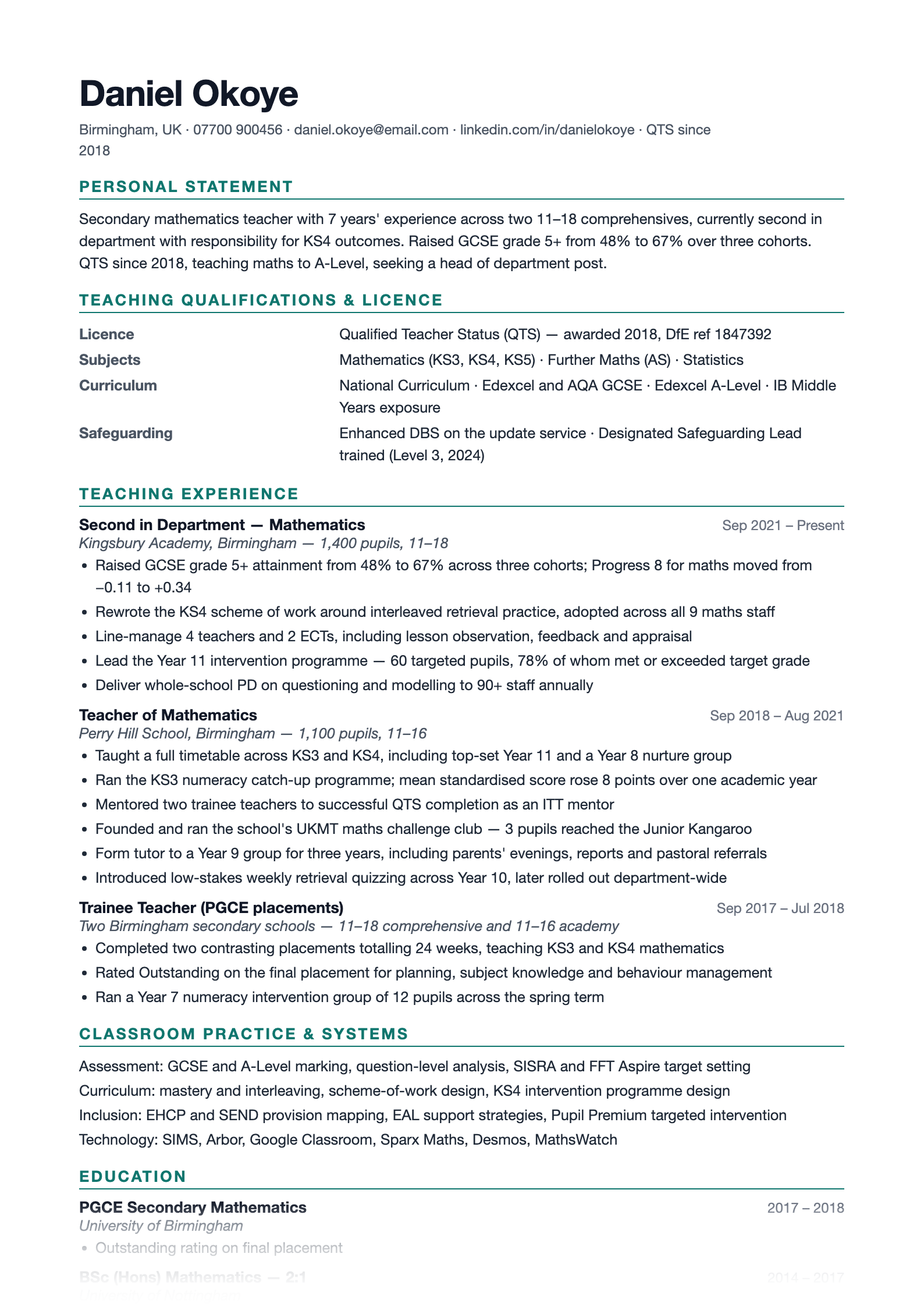
The standard teacher CV format is a two-page, single-column document in this order: contact details, personal statement, teaching qualifications and licence (QTS, state certification, B.Ed or PGCE, with the grade ranges and subjects you are licensed for), teaching experience in reverse chronological order, education, professional development, and referees. The resume format for a teacher job puts the certification block above experience because schools screen on what you are licensed to teach before they read how well you teach it. Name the curriculum you have delivered — national curriculum, IB, CBSE, Common Core, A-Level — because that is the line a head of department scans for.
This is the same document whether you call it a CV for teacher applications, a teacher CV template, a teacher resume, or a resume for a teacher job application. UK, Ireland, India and international schools say CV and expect two pages; US districts say resume and expect one to two. The free teacher CV template below is available in Word and PDF and works for both conventions.
Download Qarera's free, ATS-ready teacher CV template and teacher resume format (Word + PDF) below — no sign-up, no credit card.
Download the free teacher CV template
A filled-in two-page teacher CV — personal statement, teaching qualifications with licence and grade ranges, classroom experience with quantified attainment outcomes, professional development, and referees. Download the editable Word file or the PDF.
Free, no credit card. Bring your own resume and we'll restyle it to this template.
Free · no signup required to download
Why teacher resumes are different
Teacher resumes are screened by district HR or by a hiring committee - not the same audience as a corporate ATS, but with similar pattern recognition. The first thing they look for is licensure, in the right state, for the right grade range. If that's not visible in the top six lines, your resume goes in the no-pile before anyone reads a single bullet.
The second thing they look for is evidence the classroom you ran was the kind of classroom they'd want their own children walking into. That signal comes from quantified outcomes - proficiency rates, MAP growth percentile, behavior referral counts, parent-conference attendance - not from adjectives. "Passionate about student success" reads as filler; "raised end-of-year proficiency from 71% to 89% across 28 students" reads as evidence.
The third thing they look for is whether you'll be a colleague who pulls their weight on the grade-level team. PLC participation, mentoring student teachers, leading PD, or co-leading an intervention block all signal this. They don't have to be flashy - committee work counts - but they have to be there.
A teacher resume that does these three things in 1-2 pages will get you past the screen. A resume that buries any of them will not, no matter how strong your classroom actually was.
Teacher resume builder, free and AI-powered
Open the Teacher template inside the Qarera AI builder. Drop your experience in, paste a job description, and the builder rewrites your bullets to match. Export as a PDF in one click.
- ATS-friendly single-column layout
- AI-rewritten bullet points
- Keyword optimization vs job description
- Unlimited free PDF export
What to include on a teacher resume
Contact + work rights. Name, phone, email, city. If you hold an out-of-state license with reciprocity, mention it here in one short line - "NJ certified, NY reciprocity available."
Professional Summary (3-4 lines). Name your grade range, the subject you teach, and one quantified student outcome. Skip the generic "dedicated educator" opener. A summary that opens with "Licensed 5th-grade ELA teacher with 6 years' classroom experience; led grade-level team to a 14-point MAP growth-percentile gain over two years" is specific enough to keep a screener reading.
Certifications & Licenses. State, grade range, subject area, expiration date. Add endorsements (ESL, Special Education, Reading Specialist) and any classroom-tech certifications (Google Certified Educator, Apple Learning Coach). Districts often filter for these explicitly, so make them scannable.
Teaching Experience. Reverse chronological. School name, district, grade range, dates. Lead each role with a quantified outcome bullet, then list 2-3 supporting bullets that show breadth (curriculum design, intervention work, PLC leadership, parent communication, mentoring). Aim for 4-6 bullets per role; cut anything that doesn't have a number or a named outcome.
Education. Degree, university, graduation year. Drop GPA after 3 years out of school unless it was a 3.8+ from a notable program. Recent grads should keep GPA, relevant coursework, and student-teaching placement details.
Professional Development. Workshops you've attended OR led. "Led district PD on data-driven small-group instruction (40+ teachers attending)" is worth real estate; "attended summer PD on classroom management" usually isn't.
Technology. The LMS your district uses (Google Classroom, Canvas, Schoology), parent-comm tools (Remind, Seesaw, ClassDojo), and any data systems (PowerSchool, MAP, iReady, IXL). Five to eight items is enough - this is for keyword matching, not exhaustive listing.
Skills for a teacher CV, measured from live job postings
Every other teacher skills list is somebody's opinion. This one is a count from the live teacher jobs in our index, filtered by a test the listicles never apply: does a teaching job ask for this more often than jobs in general? “Communication” is in 31.8% of these postings — and in 32.6% of every posting we hold, so it tells a school nothing about you. “Classroom management” is in 16.3%, against 0.09% across the index. That ratio — lift — rather than the raw percentage is what earns a place below, which is why some very frequent words are missing. One requirement is missing for a different reason: our extractor does not recognise safeguarding at all, and in the UK postings it outranks everything here.
Based on 1,236 live teacher postings on Qarera (a quarter US, a quarter India, a fifth the UK, then Ireland and Canada), measured 2026-08-24.
- Classroom management16.3%
The largest number on this list, and one of the most teacher-specific terms in our whole index — 16.3% of teaching postings against 0.09% of jobs generally. The phrase alone proves nothing. Name the system (a positive-behaviour framework is named in about 5% of these postings) and the number that moved: referrals, removals, time on task, attendance.
- Early childhood education6.6%
Almost always shorthand for a named qualification rather than an interest, and the wording is country-specific. Write the credential exactly as your market states it: ECE Level 1/2/3 or RECE in Canada, your ECE unit count in the US, ECCE or NTT in India, EYFS experience in the UK.
- Child development4.9%
Sits next to credentials and record-keeping rather than theory — the CDA credential alone turns up in 3.2% of these postings. Pair the framework you assess against with how you document it, because the documentation is the part a school cannot infer from your degree.
- Professional development4.6%
Asked as a commitment to keep doing it, which is why it earns a dated block of its own on the CV rather than a bullet. List courses with years, CPD or INSET hours, your Google Certified Educator level, and any examiner or moderator work.
- Working with children4.6%
Reads as filler but it is aimed at career changers: schools want evidence you have held this age group before they read anything else, so coaching, tutoring, camp and care roles all count. It is not the Australian Working With Children Check — only 2 of the 57 postings using this phrase meant that clearance, which is asked for separately and belongs in your certifications block.
- Critical thinking4.1%
Read the sentences and this is not a trait schools want you to have; it is something they want you to build in students. Phrase it that way — the questioning routine, Socratic seminar or inquiry cycle you run, and what students produce at the end of it. Its lift is 2.6x, the weakest on this list, so hold it to one line.
- Lesson planning3.9%
Only 3.9% name it because most postings assume it, but at 156 times the rate of jobs in general it is unmistakably teacher vocabulary and a keyword filter will look for it. One line naming your planning format and the standard or board you align to is enough — do not spend three bullets proving you can plan.
- Assessment (formative and summative)2.8%
Both words appear, and the UK and Australian postings add moderation, which shows up in 3.1% of the sample. Name the instruments and the trail: what you assess with, how often, and the intervention you triggered off the results. “Data-driven” with no instrument named reads as filler.
- First aid2.7%
Undercounted at 2.7% — the phrase appears in the raw text of 7.0% of these postings, concentrated in early-years and North American roles where it is a condition of starting, and usually paired with CPR (5.6%). List the certificate, the issuing body and the expiry date; an expired certificate is worse than none.
- Patience2.6%
The one adjective that survived the filter: teaching ads use it 37 times more often than jobs in general, mostly in Indian and early-years postings, and usually inside a listed skills block rather than in prose. The word itself is worth nothing on a CV — write the settings that demanded it instead: an SEN or behavioural group, a nursery room, a class you held for three years.
- CBSE curriculum2.4%
The highest lift on this page at 188 times the corpus rate, and every mention of the board in this sample is in an Indian posting, where naming it is the screening line. Write the board and the grades — “CBSE, Grades VI–X” — and do the same for ICSE, IGCSE, IB or A-Level, which together appear in about 5% of the sample.
- Curriculum development2.3%
Distinct from lesson planning and worth its own line: postings mean units, schemes of work, and mapping to a board or standard. Say which curriculum you built against and how much of it — “wrote the Year 9 scheme of work, 36 lessons”.
- Learning styles1.9%
Kept for its lift (100x) rather than its size, and an undercount of the idea behind it: 82 of these postings use a form of “differentiate” while only 24 use this phrase, and just 5 use both. Skip both labels on the CV and describe the adjustment — the tiered task, the scaffold, the grouping — for a named group of students.
- Behavior management1.8%
The narrower, more clinical end of classroom management: named strategies, individual plans, crisis intervention. Mind the spelling — our extractor holds only the American form, so this 1.8% misses a further 18 postings that write “behaviour management”. Use whichever spelling the posting uses.
Counted across 1,236 live teacher postings indexed on Qarera on 24 August 2026, selected by job title (lower(title) like '%teacher%' or lower(title) like '%teaching%'): 330 United States, 296 India, 269 United Kingdom, then Ireland (79), Canada (60), China (46), Spain (44) and Australia (33), with 33 carrying no country. The ranking is not the raw one. Frequency alone is a trap: the most common term in these postings is “communication” at 31.8%, and it appears in 32.6% of all 372,607 postings we hold, so a teaching job is no likelier to ask for it than any other job and it tells a school nothing. We therefore scored every term by lift — its rate in teacher postings divided by its rate across the whole index — and kept only terms clearing roughly 1.5x that then survive a human read. That is why several high-frequency words are absent: “leadership” (13.5%, lift 0.8), “collaboration” (3.0%, 0.3), “written communication” (2.3%, 0.4), “verbal communication” (2.2%, 0.4), “teamwork” (2.3%, 0.8), “mentoring” (3.4%, 1.2) and “recruitment” (4.7%, 0.8) are all at or below the rate at which jobs in general ask for them; “recruitment” also reads on inspection as agency footer text rather than anything asked of a teacher. High lift alone does not earn a place either. We dropped words that restate the job (“teaching” 44.6%, lift 51; “instruction” 6.5%, lift 27), subject names that tell you which subjects have vacancies rather than what belongs in a skills section (“science” 8.4%, “art” 3.2%, “mathematics” 2.7%, “English” 2.6%, “physics” 2.2%, “geography” 1.6%, “music” 1.5%, “social studies” 1.3%), extractor artefacts that score well and mean nothing (“query” 1.6% at lift 6.4, “doors” 1.9% at 5.3, “sessions” 1.5% at 4.5, “progress” 2.4% at 4.7, “controller” 1.6% at 4.2, “https” 2.1% at 2.5, plus “materials”, “policies”, “methods”, “structured”, “processing” and “fair”), and adjectives we could not tell you how to evidence (“creativity” 3.2%, “confidence” 2.8%, “empathy” 2.3%, “positive attitude” 1.9%, “emotional intelligence” 1.3%, “energetic” 1.3%). “Patience” is the single adjective we kept, because at 37x lift it stands well clear of the others and because the settings that demand it can be named on a CV. Four terms we settled by reading the sentences they came from rather than guessing. “Safe” (6.0%, lift 2.3) is not safeguarding: every instance we read was “a safe learning environment” or “health and safety”, and the modest lift is the second signal, since a statutory British requirement in a sample a fifth British would not score 2.3x. “Discipline” (2.5%, lift 2.3) splits about evenly between classroom behaviour and “a degree in a related discipline”, with the Italian postings using it to mean school subjects, so it is unresolvable and dropped. “Coaching” (3.0%, lift 1.5) is mostly the employer offering coaching to you, a benefit rather than a requirement. And “AI” (1.9%) runs the opposite way to every advice column: it appears in 17% of all postings we hold, so a teaching job names AI roughly nine times less often than an average job, a lift of 0.1. One blind spot matters more than the ranking. Our extractor does not hold “safeguarding” as a term at all, so the requirement that dominates the British postings is absent above. Re-reading the raw description text of the same 1,236 postings: 16.0% mention safeguarding and 9.8% a DBS check — 48% and 45% respectively among the 269 UK postings, where classroom management — the largest entry above — appears in 6%, and Ofsted in 10%; 21 of the 33 Australian postings name a Working With Children Check; 14% of the 330 US postings name IEPs; 11.3% of the whole sample mentions SEN, SEND or special educational needs, where the extractor recorded “special education” in just 1.2%; and 51% mention parents, families or guardians. Those are counts of words in the description text rather than extracted skills, a looser measure than the percentages above, which is why they are reported here and not in the list. If you are applying in the UK, Ireland or Australia, the safeguarding and clearance line belongs on your CV whatever the list says. Two limits to read all of it against. This is not one national market: roughly a quarter each from the US and India and a fifth from the UK means no percentage here describes the job in front of you, and a British posting and an Indian posting in this sample want visibly different things with the blended figure sitting between them. And the sample is small in absolute terms: one percentage point is twelve postings, so read the lower half of the list as indicative rather than precise. We stopped the list at 1.8%, or 22 postings of support, rather than pad it out with terms we could not stand behind. Near-duplicates would be merged and reported under the higher-counting term only, never added together; after the lift filter no merge was needed here.
Hard and soft skills for a teacher resume
The measured list above tells you what employers ask for. This one sorts the vocabulary into the two groups a screener treats differently: hard skills a keyword scanner can verify, and soft skills that count only when a bullet proves them.
Hard skills
- •Lesson planning aligned to Common Core / state standards
- •Differentiated instruction for IEP and 504 students
- •Classroom management for K-12 grade levels
- •Safeguarding and child protection (DBS, Garda vetting, Working With Children Check)
- •Formative and summative assessment design
- •LMS platforms (Google Classroom, Canvas, Schoology)
- •Data-driven instruction and progress monitoring
- •Parent-teacher communication tools (ClassDojo, Remind, Seesaw)
- •Curriculum design and unit mapping
- •Co-teaching and inclusion models
Soft skills
- •Patience under sustained pressure
- •Cross-cultural communication
- •Conflict de-escalation with students and parents
- •Collaboration in PLCs (professional learning communities)
- •Adaptability across in-person, hybrid, and remote formats
- •Mentoring student teachers and new colleagues
ATS keywords for teacher resumes
These are the terms applicant tracking systems are tuned to find on a teacher resume. Embed them naturally in your bullets and skills section - don't list them as a flat keyword wall.
Sample teacher resume bullets
Use these as a model - replace the numbers and contexts with your own. Every bullet leads with a quantified outcome, not a duty.
- 1
Designed and taught a Common Core-aligned 5th-grade ELA curriculum for 28 students; 89% reached or exceeded grade-level proficiency on end-of-year state assessments, up from 71% the prior year.
- 2
Differentiated instruction for 6 IEP and 3 504 students by building tiered task ladders, raising on-track-to-graduate rates from 78% to 94% over two years.
- 3
Implemented a Google Classroom workflow that cut weekly grading time from 9 hours to 4 while increasing assignment-return rate by 31%.
- 4
Co-led a grade-level PLC of 5 teachers, establishing a shared formative-assessment cadence that lifted MAP growth-percentile scores by 14 points across the team.
- 5
Reduced classroom behavior referrals by 62% in one school year by introducing a restorative-circles routine and partnering with the counseling team on Tier 2 supports.
- 6
Mentored 2 student teachers through their full clinical placement; both received 'highly effective' on their final evaluations and were hired by partner districts.
- 7
Built and deployed a parent-communication system using Remind and weekly Friday emails; parent-conference attendance rose from 54% to 88% over one year.
- 8
Earned 'Teacher of the Year' nomination twice (2023, 2024) and led a district-wide PD session on data-driven small-group instruction attended by 40+ colleagues.
Recommended resume structure
Section order matters. ATS systems and human screeners both expect this layout for teacher resumes.
- 1Contact
- 2Professional Summary
- 3Certifications & Licenses
- 4Teaching Experience
- 5Other Relevant Experience
- 6Education
- 7Professional Development
- 8Technology & Skills
Put Certifications above Experience for K-12 roles. District HR screens for state licensure (and any out-of-state reciprocity) within the first 8 seconds. After that, lead each Experience entry with a quantified student-outcome bullet - not a duties list.
Relevant certifications
- State teaching license (specify state and grade range)
- ESL / TESOL / Bilingual endorsement
- Special Education endorsement
- Reading Specialist or Literacy endorsement
- National Board Certification (NBCT)
- Google Certified Educator (Level 1 or 2)
- Apple Learning Coach
- Master's in Education or content-area MA
Salary range (USD)
$45,000 – $78,000
Median $62,000
Source: bls.gov · As of 2025-05-01
Common mistakes on teacher resumes
Listing duties instead of outcomes
"Taught 5th-grade ELA" is a duty. "Designed and taught 5th-grade ELA curriculum; 89% reached or exceeded grade-level proficiency, up from 71% the prior year" is an outcome. Every bullet should have a number or a named result, or it shouldn't be there.
Burying the license
Your state license, grade range, and any endorsements have to be visible in the first half of page 1. District HR screens for this in seconds; if they have to scroll past four jobs to find it, they often won't.
Generic 'classroom management' bullets
Every teacher manages a classroom. Bullets that just say "managed classroom of 28 students" don't differentiate you. Replace with a specific system you implemented and a specific result - "reduced behavior referrals 62% by introducing restorative circles + Tier 2 partnership with counseling."
Two pages without enough content to fill them
If you have under 8 years of experience, one page is the right call. Stretching to two pages with white space and small adjustments to old roles signals you're padding. Cut to one solid page instead.
Forgetting the LMS and data tools
Districts ask for specific tools in the posting. If you used Google Classroom, MAP, iReady, IXL, or PowerSchool, those words need to appear on your resume - not just in the skills section, but woven into bullets where you actually used them.
Soft skills without proof
"Strong communication skills" is meaningless on a teacher resume. Replace with a sentence that proves it - "raised parent-conference attendance from 54% to 88% via Remind and weekly Friday parent emails."
Need a cover letter too?
A teacher resume gets you screened in. The cover letter gets you interviewed. We have a free generator and a teacher-specific template ready to use.
Teacher cover letter examples →Frequently asked questions
Related roles
Academic / PhD Resume
Free template, examples, and ATS keywords for academic / phd resumes.
Customer Service Representative Resume
Free template, examples, and ATS keywords for customer service representative resumes.
Manager Resume
Free template, examples, and ATS keywords for manager resumes.
Federal Resume
Free template, examples, and ATS keywords for federal resumes.
Build a teacher resume in 10 minutes
Free template, AI rewrites, ATS-tested. No watermark.
Free forever · Works with every major ATS · No credit card
Build my resume free